

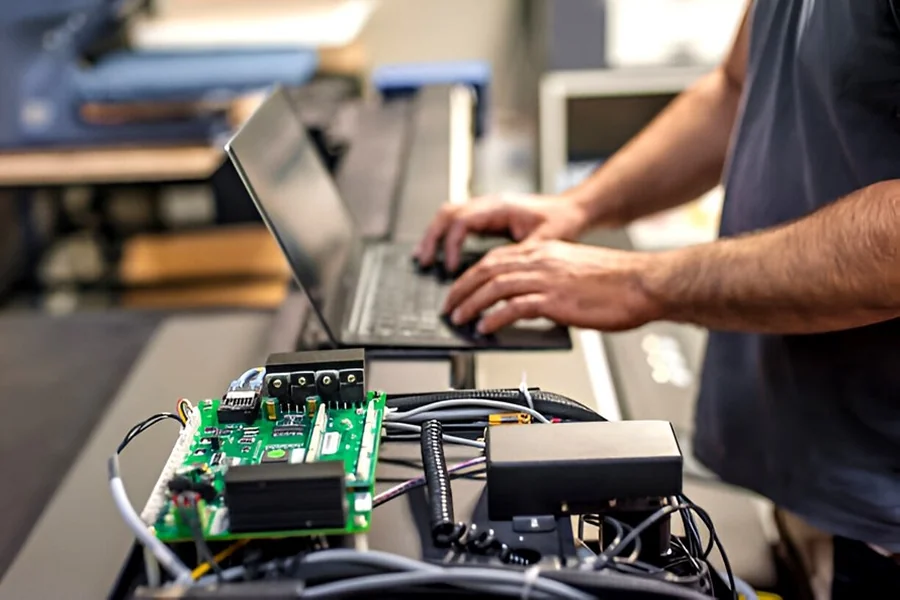
Flex PCB assembly refers to the process of manufacturing and assembling flexible printed circuit boards that can bend, twist, and fold without breaking. Unlike rigid PCBs, these boards are designed using flexible polyimide materials that offer remarkable durability, heat resistance, and adaptability. Flex PCB assembly has become an essential part of modern electronics because it supports compact designs, complex shapes, and highly reliable connections in products where space is limited or frequent movement occurs.
Flexible circuits are now widely used in wearables, medical devices, automotive systems, aerospace equipment, and industrial automation. Because they can withstand mechanical stress and repeated flexing, flex circuits provide unmatched performance where rigid boards simply cannot perform. Today, flex PCB assembly stands at the center of innovation, enabling lighter, slimmer, and more efficient electronic designs.
Why Flex PCB Assembly Matters in Modern Electronics
Compact Designs with Greater Freedom
One of the biggest advantages of flex PCB assembly is its ability to support compact, high-density designs. Traditional rigid PCBs require multiple boards connected with cables or connectors, which increases bulk and creates potential failure points. Flex circuits remove the need for connectors by allowing the PCB to bend around corners and curves. This makes them highly valuable in devices like smartphones, hearing aids, medical sensors, smartwatches, and military-grade electronics.
Exceptional Durability and Reliability
Flex PCBs are engineered from polyimide, a material known for its high heat resistance, dimensional stability, and durability. As a result, flex PCB assembly creates boards that can operate reliably under vibration, movement, and repeated stress. Industries that rely on precision—such as aerospace, defense, industrial automation, and automotive—trust flex PCBs because they maintain stable electrical performance even in harsh conditions.
Improved Signal Integrity
The streamlined design of flex circuits leads to shorter interconnection paths and fewer components. This reduces potential interference and improves signal integrity. Flex PCB assembly is ideal for high-speed and high-frequency applications where signal quality is critical.
Key Materials Used in Flex PCB Assembly
Polyimide Base Material
Polyimide serves as the core flexible substrate due to its flexibility, heat resistance, and long-term stability. It is typically used in layers, depending on whether the project requires a single-layer, double-layer, or multilayer flex PCB.
Adhesives and Copper Foil
The copper foil forms the conductive layer, while adhesives bond the circuit layers. In high-performance flex PCB assembly, adhesive-less structures are often preferred to enhance reliability and reduce the risk of delamination.
Protective Coverlay
Coverlay replaces the solder mask used in rigid boards. It protects the copper and keeps the board flexible while maintaining insulation and durability.
Flex PCB Assembly Process Explained
Design Preparation and Engineering
The process begins with engineering analysis, where designers review the bend radius, trace width, component placement, and layer count. Design for Flexibility (DFF) guidelines ensure the board can withstand continuous movement without damage. Engineers also verify that the design avoids stress points, sharp bends, or overlapping copper traces that may crack during flexing.
Fabrication of the Flexible Circuit
During fabrication, copper layers are laminated onto the polyimide substrate. The circuit pattern is etched, drilled, and plated based on the design requirements. For multilayer flex circuits, bonding is completed with precision to maintain flexibility while achieving the required electrical performance. The coverlay is then applied, and cutouts are made for soldering areas or components.
Component Mounting and Assembly
Flex PCB assembly typically uses advanced SMT (Surface Mount Technology) machines capable of handling thin and delicate materials. The PCB is stabilized using jigs or carriers to prevent warping during assembly. Reflow soldering profiles are carefully controlled because polyimide substrates absorb heat differently than rigid boards. In some projects, a combination of SMT and manual soldering is used to handle components located near bend zones.
Testing and Quality Assurance
Inspection is a critical stage, especially when assembling flexible boards. AOI (Automated Optical Inspection), X-ray scanning, electrical testing, and bend testing verify that the PCB maintains mechanical strength and electrical stability. Finished boards must withstand both environmental stress and repeated movement, depending on the application’s requirements.
Types of Flex PCB Assembly
Single-Layer Flex PCB
These are the simplest type, ideal for basic circuits and low-density applications.
Double-Layer Flex PCB
Used when more routing space is required, offering better functionality while remaining flexible.
Multilayer Flex PCB
These support high-density and high-performance applications with complex circuitry and multiple copper layers.
Rigid-Flex PCB
A combination of rigid and flexible sections, used in advanced electronics like drones, cameras, military equipment, and medical imaging devices.
Applications of Flex PCB Assembly
Flex PCB assembly plays a vital role in various industries, including:
Consumer Electronics
Smartphones, foldable devices, Bluetooth modules, and wearable technology rely heavily on flex PCBs.
Medical Devices
Pacemakers, insulin pumps, imaging tools, and portable monitors require flexible circuits for compactness and reliability.
Automotive and Aerospace
Flex PCBs are used in ADAS systems, dashboards, sensors, satellites, communication modules, and radar systems.
Industrial Automation
Flexible circuits support robotics, sensors, actuators, and high-precision production equipment.
Why Choose Professional Flex PCB Assembly?
Professional flex PCB assembly ensures the right materials, design guidelines, and manufacturing techniques are used to achieve long-term durability and performance. Flex circuits require expertise because even minor design or assembly flaws can lead to cracking, delamination, or electrical failure. Working with an experienced flex PCB specialist ensures stability, reliability, and performance in high-stress environments.
Looking for a Reliable Partner for Flex PCB Assembly?
If you are planning to develop flexible circuits for industrial, consumer, or medical applications, partnering with a trusted Chinese PCBA provider can help you achieve high-quality, cost-efficient flex PCB assembly with advanced engineering support and fast production.
